WHO Code: World Health Organization

“Those who make claims about infant formula that intentionally undermine women’s confidence in breastfeeding are not to be regarded as clever entrepreneurs just doing their job but as human rights violators of the worst kind.”
Aim of the Code – Article 1
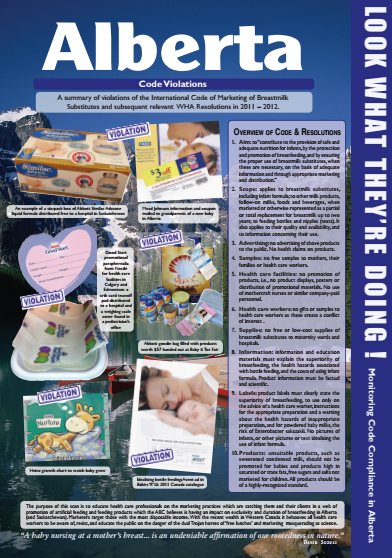
The aim of this Code is to contribute to the provision of safe and adequate nutrition for infants, by the protection and promotion of breastfeeding, and by ensuring the proper use of breastmilk substitutes, when these are necessary, on the basis of adequate information and through appropriate marketing and distribution.
Aim of the Code – Article 2
The Code applies to the marketing, and practices related thereto, of the following products: breast-milk substitutes, including infant formula; other milk products, foods and beverages, including bottle fed complementary foods, when marketed or otherwise represented to be suitable, with or without modification, for use as a partial or total replacement of breast milk; feeding bottles and teats. It also applies to their quality and availability, and to information concerning their use.
The International Code of Marketing of Breastmilk Substitutes and subsequent relevant WHA Resolutions (‘the Code’)
The Code is a World Health Assembly Resolution; a recommendation that nations pass legislation to uphold the resolution. However there is no legal penalty if a nation does not implement a resolution they adopted. Canada endorsed the 1981 WHA Resolution which became The Code and has endorsed all subsequent relevant Resolutions. It is a voluntary code. Canada has put only a few provisions from The Code into law, mostly around labeling.
The WHO Code and subsequent WHA Resolutions are designed to protect ALL mothers and children.
-
• Formula milk
• Any food or drink that would substitute for breastfeeding e.g. teas or foods aimed at babies under six months, of formula aimed at any age
• Bottles
• Teats or nipples
-
• Manufacturers, distributors, and retailers of any of the above items
• Health care workers, both professionals and volunteers
• Health care facilities – hospitals, clinics, etc.
-
• Labels must be in the local language
• Information must include the hazards associated with artificial feeding
• Labels cannot use idealizing language or images e.g. a happy baby sleeping, or a protective shield suggesting baby is in a protected bubble against disease
-
• Use of formula with safe preparation, for babies who need it
• Sale of products with technical information e.g. “125 ml polycarbonate bottle”
• Scientific and factual information for health professionals e.g. “contains certain proteins”
• Accurate information on safe formula preparation is required on all labels
-
• Promotion to parents: advertising, free samples
• Promotion to health professionals: gifts, free samples
• Promotion in health facilities: posters, free formula, gifts
• Promotion of unsuitable products for babies (such as sweetened condensed milk)
WHO Code Resolutions
When the International Code was adopted by the World Health Assembly in 1981 (see Resolution WHA34.22) it was recognized that it may require clarification or even revision. Accordingly Resolutions have been adopted every 2 years since 1982. The subsequent Resolutions have equal status to the International Code and close many of the loopholes exploited by the baby food industry…

-
![]()
Clinical Management Covid-19-May27
-
![]()
FAQ Code Healthworkers WHO
-
![]()
2020 Code Status WHO
-
![]()
WHO Code FAQ 2017
-
![]()
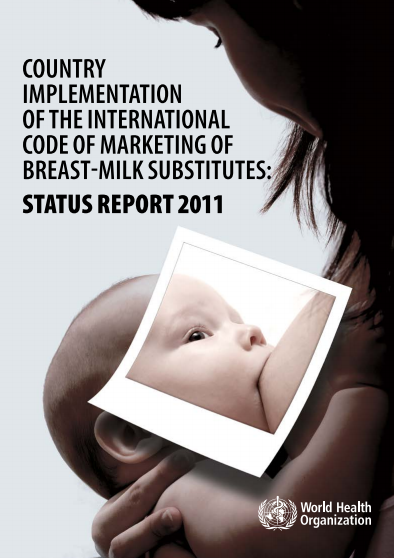
WHO Code Country Implementation of The Code 2011
-
![]()
WHO Code – LWTD in Canada